Why Your Proposal Process Is Losing You Tenders
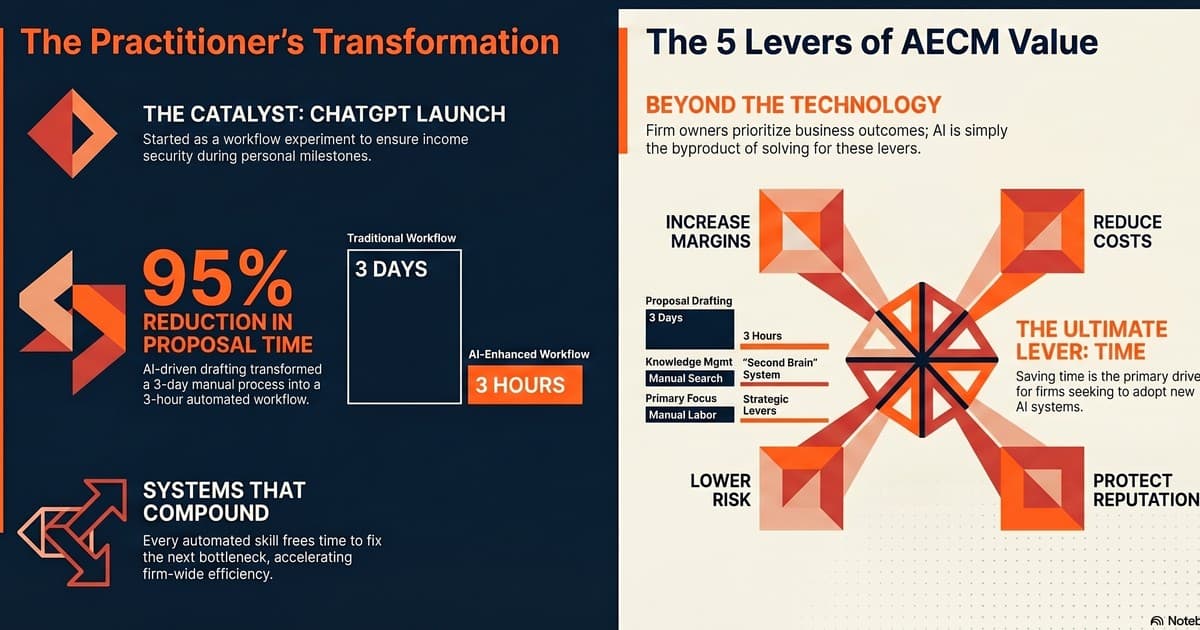
Most AEC firms lose tenders before they submit. Not on price. On process. Here's the pattern, and what the firms that win 65% of the time do differently.
Most AEC firms lose tenders before they even submit. Not because their technical score is weak. Because their proposal process is a last-minute scramble that produces generic documents no evaluator remembers.
I've seen this pattern across 50+ tender evaluations — on both sides of the table. As a submitter at ACE Consultancy. As part of evaluation panels. As the director getting the call from a colleague saying "we came second again." The pattern repeats, and it has almost nothing to do with price.
The pattern every evaluator sees
If you've ever read a stack of tender responses in one sitting, you know what I mean. By the fifth submission, you stop noticing the technical content. You start noticing the shape of the document. Who cared. Who didn't. Who wrote it the night before.
Here's the losing pattern, as it shows up in the file:
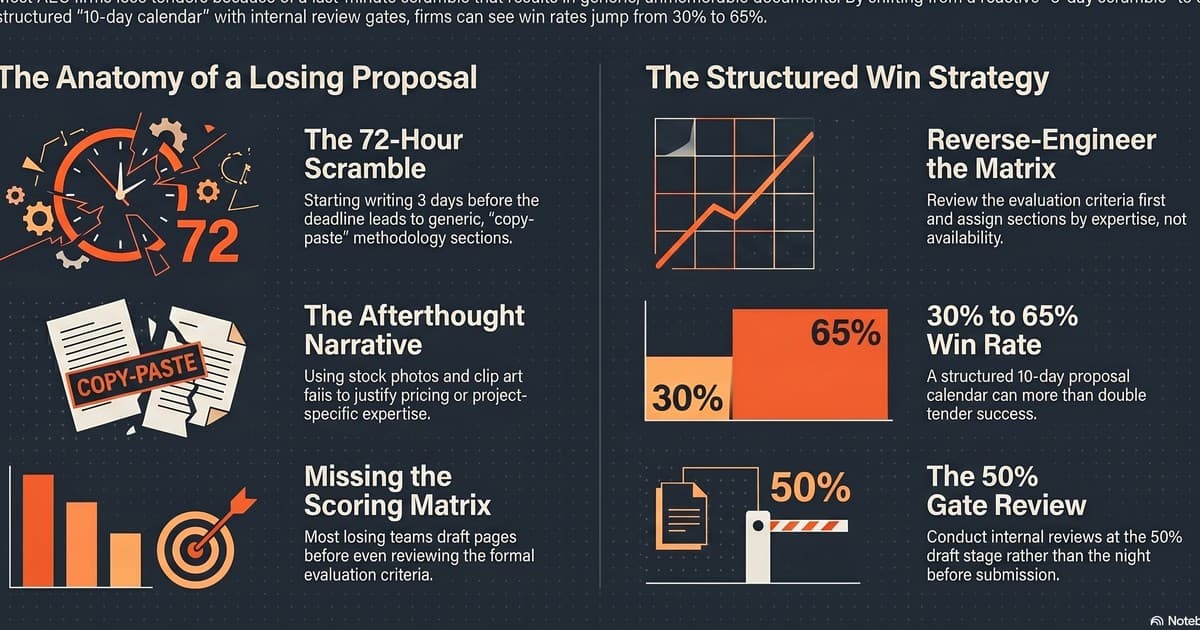
- The team starts writing 3 days before the deadline. You can feel it. The methodology reads like a draft, not a plan. Cross-references break. Formatting drifts between sections.
- Nobody reviews the evaluation criteria until page 2 is already drafted. The document answers questions the client didn't ask and skips questions they did.
- The methodology section reads like it was copied from the last project. Generic phrases, recycled diagrams, no specific reference to this client's stated risks or objectives.
- Graphics are an afterthought. Stock photos. Clip art. Organization charts that look like they came from a Word template. No visual hierarchy. No effort to help the evaluator navigate.
- The price is competitive, but the narrative doesn't justify it. The number sits in a cost table with no story connecting it to the value delivered. The evaluator has no reason to defend your price against a cheaper competitor.
Any one of these is survivable. Three or more and you're done. And most losing proposals have all five.
The uncomfortable truth is that your proposal is the only thing the evaluator sees. They don't know how clever your team is. They don't know how good your last project was unless your CVs and case studies say so specifically. They don't know that you would have done a great job. They only know what's on the page. If the page looks rushed, you are rushed. If the methodology looks copy-pasted, your approach is copy-paste.
What the firms that win consistently do differently
The firms I've watched win consistently — 50%+ win rates, year after year, in competitive markets — do three things that most firms don't.
They reverse-engineer the scoring matrix before they write anything.
Before a single paragraph gets drafted, someone senior reads the evaluation criteria and builds an internal scoring map: how many points per section, where the discretionary weighting lives, which criteria are pass/fail versus comparative. That map becomes the skeleton of the proposal. Every paragraph has to earn a specific point. If it doesn't, it's cut or rewritten. This one habit alone separates the 30% win-rate firms from the 60% win-rate firms.
They assign sections by expertise, not availability.
Weaker firms ask "who's free this week?" and hand out sections based on capacity. Stronger firms ask "who has the strongest specific experience to defend this section under evaluator questioning?" and protect those people's time to write it. Availability-based drafting produces generic proposals. Expertise-based drafting produces credible ones. You can feel the difference in one paragraph.
They review against criteria at 50% draft — not the night before submission.
The single most expensive mistake in AEC proposal work is leaving the first real review until the document is 95% done. At 95% done, the structure is locked. You can polish. You can't restructure. The firms that win run a formal review at the 50% mark — against the scoring matrix, not against general quality — and they're willing to rip out entire sections if the answer to "what point is this earning?" isn't clear.
Add a second review at 80%, a proof at 95%, and a final sign-off the day before submission, and the win rate moves.
One firm's data point
One firm I know well went from a 30% win rate to 65% in 18 months. The only change was a structured 10-day proposal calendar with three internal review gates.
- Day 1–2: scoring matrix, outline, section assignments, client-specific risk map.
- Day 3–6: first drafts, expertise-assigned, no editing.
- Day 7: 50% review against scoring matrix. Restructure if needed.
- Day 8: second drafts.
- Day 9: 80% review. Edit for narrative, not just grammar. Check all graphics against section claims.
- Day 10: proof, sign-off, submit with 24 hours of buffer.
They didn't hire anyone. They didn't buy new software. They didn't change their technical capability. They changed the process, and the process changed the outcome. Same engineers. Same rates. Double the win rate.
This is what most firms don't internalize: your proposal process is the product your evaluator experiences. The technical work behind it doesn't matter if the package arrives scrambled. Fix the process, and the wins follow — sometimes immediately, always within two submission cycles.
Where to start this week
If your own win rate is under 30% and you're blaming price, the odds are it's not price. Before you cut another point off your rates, answer three questions honestly:
- When does your team start writing, relative to the deadline?
- When does someone senior first read the evaluation criteria?
- What percentage of your methodology text is specific to this client's stated risks — and what percentage is recycled from previous submissions?
If the honest answers are "3 days out, after page 2 is drafted, and about 20%," your process is the problem. Not your price, not your team, not the market. The fix is not a new tool. It's a calendar, a scoring map, and three review gates.
If you want to see where your firm stands on this and four other high-leverage operational levers, the free AI Readiness Audit covers it — 7 questions, your own 2-page playbook, and a specific starting point.