How an AI Consulting Firm Emerged From an Engineering Firm
I didn't set out to build an AI company. I set out to fix my own firm. The rest happened because the results were too visible to ignore.
I didn't set out to build an AI company. I set out to fix my own engineering firm. The consulting practice came later, and it came because the results were too visible to hide.
When ChatGPT first launched, I dabbled. It didn't click. But the signal kept getting louder — more content, more tools, more stories about firms quietly pulling ahead. One thought kept circling: if my competitors adopt this and I don't, where does that leave me?
At the time I wasn't a director or a shareholder yet. First child on the way. Building a house. I needed income security. But I also wanted to build something of my own — a backup that could become the main thing. So I started where I had the most control: my own workflows inside ACE Consultancy.
Fixing my own firm first
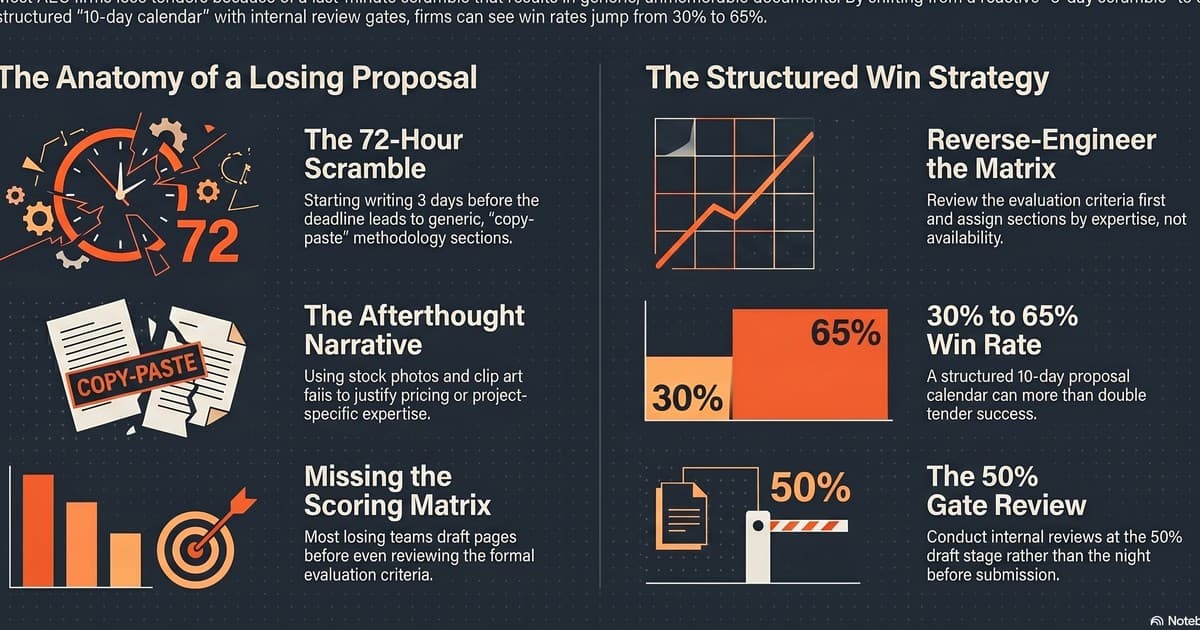
The first workflow I rebuilt was proposal drafting. We were running a 15-person civil engineering consultancy in Suriname, and every tender was a scramble. We dug up old reports, pulled numbers from memory, hoped the format matched what the client wanted, and lost sleep the night before submission.
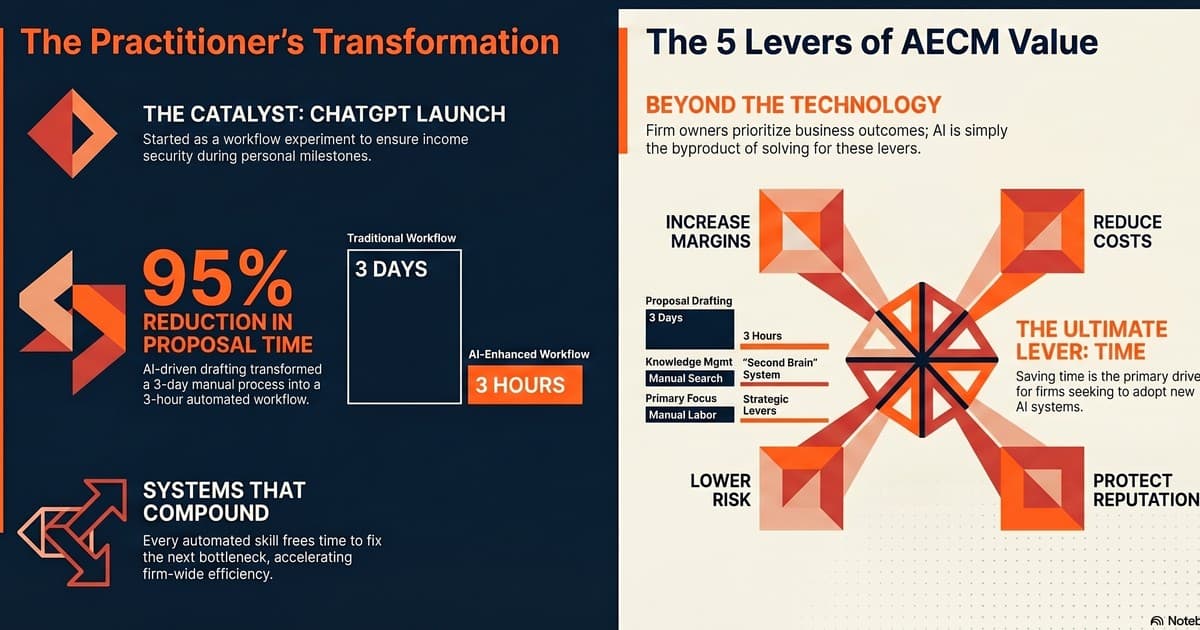
I rebuilt it with AI in the loop — structured inputs, reusable methodology blocks, a proposal library that kept improving with every submission. Proposal drafting went from 3 days to 3 hours. That was the moment it clicked. Not because the tool was magic, but because the process was finally documented, and the AI was holding the documentation accountable.
Email handling was next. Classification, drafting, triage — semi-automated, trained on my actual voice and my actual inbox. Then project correspondence. Then a second brain that ingests everything I read, write, and decide, and gets measurably smarter every week because everything feeds back into it.
That's the part people miss about AI in an engineering firm. It's not one tool. It's compounding. Every agent you build, every workflow you systemize, every skill you automate frees time to fix the next one — and the next one is always faster, because the scaffold is already there.
Why this stopped being a hobby
At some point other firms started asking how. Engineers I knew, directors I'd worked with on tenders, owners at firms half my size and three times my size. Same question every time: "How are you actually doing this?"
That's how SigmaMetrix started. Not with a business plan. Not with a pitch deck. With the results I was getting at my own firm, and a stack of people asking to see under the hood.
What I learned from those conversations is the thing I wish I'd known three years ago:
AEC firms don't care about the technology. They care about five things.
- Can you increase margins?
- Can you reduce cost?
- Can you lower risk?
- Can you protect reputation?
- Can you save time?
That's the whole list. Every owner I've spoken to — from 5-person practices to 200-person firms — filters every pitch through those five levers. Technology is just the by-product. If you can't tie the tool to at least one of those outcomes in a specific, measurable way, you don't have an offer. You have a demo.
The unfair advantage of building from inside
The conventional path for AI consultants is the opposite of mine: start the consultancy, then figure out how to prove value. That path is fine. It's also crowded, and it produces a lot of slide decks and very few case studies.
I had an accidental advantage. ACE is the case study. Every system I sell through SigmaMetrix has been beaten up in an operating firm with deadlines, angry clients, government bureaucracy, and a team that will tell me to my face when something doesn't work. That's not a marketing position. It's a filter. The things that survive that filter are the only things I offer externally.
If you're running an AEC firm and thinking about where to start with AI, three things from the inside:
- Pick one workflow you already hate. Proposals, permits, progress claims, meeting notes — whatever wastes the most time per week. Don't ask "how can we use AI?" Ask "what's the most expensive repeatable task in this firm?" Start there.
- Rebuild the workflow around the tool, not on top of it. The biggest mistake I see is firms buying subscriptions and bolting them onto broken processes. You don't save time. You generate the same mess faster. Map the workflow step by step first. Then pick the tool.
- Measure the time saved, in writing, after 30 days. If you can't point to a number, the tool isn't earning its keep. Kill it and try a different one. The cost isn't the $20/month subscription — it's the attention tax of running something that doesn't pay off.
That's the approach that took ACE from founder-dependent to systemized, and it's the same approach I use with every firm SigmaMetrix works with now.
What I'd do if I were starting today
If you're an engineer or an owner at an AEC firm reading this and wondering whether AI is worth your attention yet — the window where it was optional is closing. Not because of hype. Because the firms that figure this out compound month over month, and the firms that don't lose ground quietly, for reasons that won't show up on a P&L until it's too late to catch up.
The good news is you don't need a strategy. You need one workflow, one tool, and 30 days.
Pick the workflow you hate most. Start there. The rest is compounding.
Want to see where your firm stands? Take the free AI Readiness Audit — 7 questions, your own 2-page playbook, no sales call.